What must giveaway rules cover?
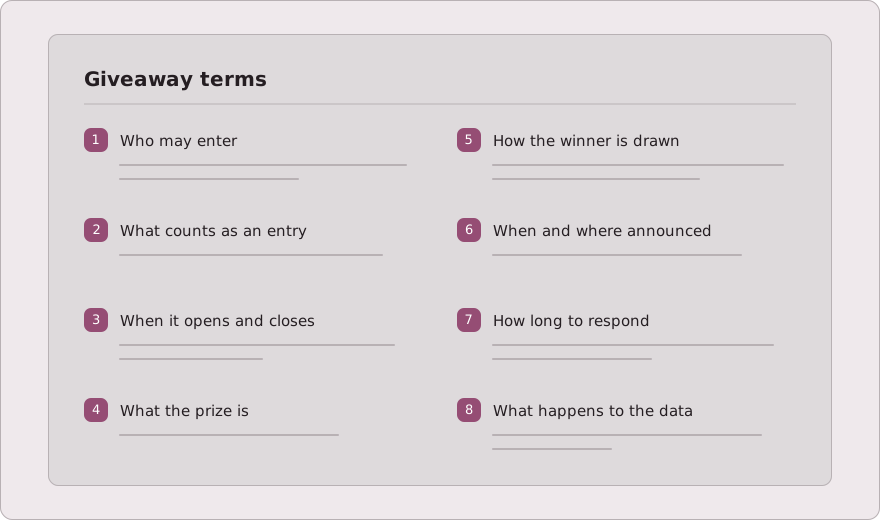
Eight things, and every dispute you have ever seen under a giveaway post traces to one of them being missing: who may enter (age, region), what counts as an entry, when entries open and close — with a timezone — what the prize exactly is, how the winner is drawn, when and where they are announced, how they are contacted and how long they have to respond, and what happens to entrants’ data afterwards.
Each clause is one or two sentences. The whole document fits in a caption comment or a linked note, and the test for every line is the same: could two reasonable people read it and disagree? “Ends Friday” fails that test; “ends Friday 31 July, 18:00 CET” passes it.
Which lines do the platforms themselves require?
Instagram and Facebook require promotions to acknowledge that the platform is not sponsoring, endorsing or administering them, and to carry official rules — the acknowledgment is one sentence you reuse forever. YouTube’s contest policies require free entry and a link to your rules, and forbid entry mechanics that violate its guidelines.
TikTok’s rules sit in its promotion guidelines and its branded-content policy, and Twitch inherits whatever your prize and region require plus its own terms. None of these documents is long, and the habit that pays is reading the one page that applies before the post goes out — the platforms change details, and your saved wording should carry a checked date.
How do you keep bonus entries enforceable?
Only promise what you can count. “One extra entry per tagged friend, up to three” is countable from the comments; “extra entries for sharing to your story” is only countable for public accounts, and a rule you cannot verify is a dispute you have scheduled in advance.
Cap the multiplier and write the cap down. Bonus entries exist to reward enthusiasm, not to let one entrant buy the wheel — and when the entries go on a wheel as weights, the cap is what keeps the picture readable and the giveaway looking like one.
What should the rules say about things going wrong?
Three cases repay one sentence each, written before you need them. A silent winner: how long they have to respond, and that an unclaimed prize is redrawn — in the open, from the same list. An ineligible winner: checked after the draw, redrawn if the check fails, with the reason stated. An unavailable prize: replaced with an equivalent, never quietly downgraded.
The pattern behind all three is the same one the drawing method follows: decisions made in advance read as rules, and decisions made after the draw read as favouritism — whatever the intent was.
Where do the rules live, and can they change?
The short version lives where the entries happen — the caption, the description, the pinned comment — and the full version one tap away: a linked page, a story highlight, a pinned note. Keep a dated copy of what was published; the version entrants saw is the version that binds you.
Once entries open, the rules freeze. If something truly must change, extend rather than restrict — a longer window wrongs nobody, a shortened one wrongs everyone who planned on it — and announce the change as visibly as the giveaway itself.
Write usable rules in five steps
Keep reading, or start drawing
The Instagram guide runs the whole campaign these rules sit inside, and the online raffle guide covers the draws where entry costs money and the rules stop being optional.
Terms written, the draw is the easy part: the Instagram giveaway picker makes the bonus-entry clause visible as segment widths, and the plain name wheel draws any list your rules produce.